Definition of Done
/AI/4 min read
A loop stops when its checker passes, so the checker sets a ceiling on quality that no number of attempts can lift. Tightening the checker buys more than improving the model does.
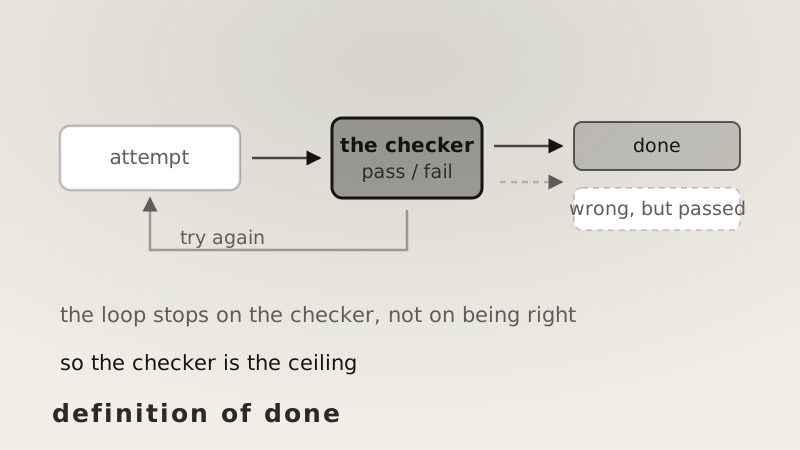
A definition of done is two things: a goal, and a way to check the goal. The second half is the one that gets left out, and it is the one that decides whether a model can work on the task at all.
Exact, and fuzzy
Some definitions of done are mechanical:
applyBulkDiscount(1000, 20)returns800- the project compiles with no errors
- this query returns exactly these 14 rows
- the reported bug no longer reproduces
Each of those is a command with an exit code. No judgement involved, no disagreement possible.
Others are not:
- "build the sign-in flow"
- "write a good summary"
- "make this module more readable"
- "design a clean structure for this"
These are not vague because whoever wrote them was careless. They are genuinely underspecified — "build the sign-in flow" leaves open what happens when the network drops mid-request, how long a session lasts, what the error message says, and what counts as acceptable structure. Those decisions exist whether or not anyone wrote them down.
Why the checker sets a ceiling
Here is the part worth making precise.
A loop attempts the work, runs the checker, and stops when the checker passes. So what the loop produces is not "correct output" — it is whatever passes the checker. Those are the same thing only if the checker is perfect.
Say each attempt is genuinely correct 55% of the time, and some fraction of wrong attempts pass the checker anyway:
| wrong answers the checker lets through | output actually correct |
|---|---|
| 0% | 100.0% |
| 5% | 96.1% |
| 10% | 92.4% |
| 15% | 89.1% |
| 25% | 83.0% |
| 40% | 75.3% |
That is a ceiling. More attempts do not raise it — they raise the chance of stopping, and the stopping condition is what is flawed. A loop with a 25% false-pass rate produces wrong output 17% of the time no matter how long it runs.
And the leverage sits entirely on the checker:
| change | resulting ceiling |
|---|---|
| tighten the checker from 25% to 5% false passes | 83.0% → 96.1% |
| improve the model from 55% to 75% per attempt, checker unchanged at 25% | 83.0% → 92.3% |
Tightening the checker beats improving the model, and it is usually the cheaper of the two.
What the checker buys besides quality
It also decides who has to be present.
With a perfect checker and a 55% per-attempt success rate, four attempts reach 95.9%. The model runs those four attempts on its own, and a person looks at the result once.
Without a checker, every attempt needs a human to say whether it worked. Same four attempts, four reviews — and the person is now the slow part of a loop that was supposed to save their time.
That is the practical reason this matters more for agents than for chat. A single response gets read by a person anyway. A loop that is supposed to run unattended cannot run at all without something to tell it when to stop.
Moving a fuzzy goal toward a checkable one
The work is not writing the goal more forcefully. It is naming the decisions the goal left open.
"Make this module more readable" becomes:
- no function longer than 40 lines
- no nesting deeper than three levels
- every exported function has a doc comment
- the existing test suite still passes
- the public interface is unchanged
None of those is readability. Together they capture enough of it to be checkable, and the residue — whether the naming is good, whether the structure makes sense to someone new — is the part that genuinely needs a person.
That split is the useful output of the exercise. You end up with a mechanical part a loop can grind on, and a small judgement-shaped part for review. Which is a much better division of labour than handing over the whole fuzzy thing and reviewing all of it.
The honest limit
Some work has no exact checker and never will. Is this design right for where the product is going. Is this abstraction one someone will understand in a year. Does this summary emphasise what the reader cares about.
For those, a model is a source of drafts and a person is the definition of done. That is a legitimate way to work and it is worth recognising as different — it does not become an unattended loop by being wrapped in one.
What to take away
Before handing work to a model, answer one question: what command tells me this is finished?
If there is one, the loop can run itself, and the effort belongs in making that command strict — because the loop's ceiling is the checker's precision, and no amount of model improvement or extra attempts moves it. If there is not one, say so, and plan for a person in the loop rather than discovering it when the output is confidently wrong.