Hybrid Search
/AI/4 min read
Keyword and vector search fail on opposite queries, so run both. The hard part is combining two ranked lists whose scores are not on the same scale — and the constant in the standard fix quietly decides your ordering.
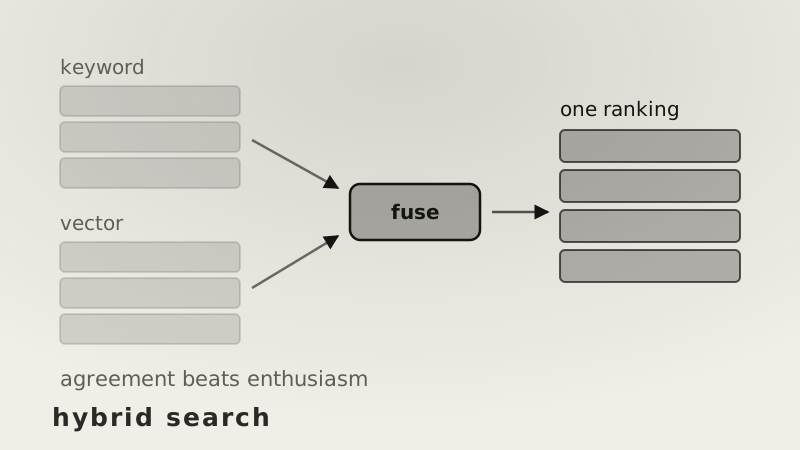
Two ways to find a document, with complementary blind spots.
Keyword search scores a document by which query words it contains, weighted by how rare those words are in the collection. It is exact. A part number, an error code, a person's name — it finds them because it is matching the literal string.
It also finds nothing when the document says the same thing in different words. Search for "card declined" and a page titled "payment rejected" does not appear at all. Not ranked low — absent.
Vector search compares meaning, so it handles that case. It also fails in the opposite direction: asked for an exact identifier, it returns things that are about identifiers, because a rare token contributes little to an embedding built to capture overall meaning.
Neither is a superset of the other, so the answer is to run both. That part is easy. Merging the results is not.
Why you cannot just add the scores
Keyword scores are unbounded and query-dependent. The top score for one query might be 18.4, for another 3.2, for another 41.7 — it depends on how rare the words are and how long the documents are.
Cosine similarity is bounded in a narrow band, typically 0.7 to 0.9 for anything worth returning.
So "add them with weights" is not well defined. A weight that balances the two for one query over-weights the keyword side for the next. The usual patch is to normalise each list — map its best to 1 and worst to 0 — but that introduces a distortion of its own: the lowest-scoring document you retrieved gets exactly zero, whatever its actual score was, purely because it came last.
Fusing ranks instead
Reciprocal rank fusion discards the scores and uses only positions. Each document gets 1 / (k + rank) from every list it appears in, summed.
Take a query where the two searches disagree:
| keyword list | vector list | |
|---|---|---|
| 1 | D1 (18.4) | D3 (0.81) |
| 2 | D2 (12.1) | D7 (0.79) |
| 3 | D3 (9.6) | D2 (0.76) |
| 4 | D7 (4.2) | D9 (0.71) |
D1 is the keyword search's clear favourite — a score of 18.4 against the runner-up's 12.1 — and the vector search does not return it at all.
Fused with the standard constant:
| fused score | |
|---|---|
| D3 | 0.03227 |
| D2 | 0.03200 |
| D7 | 0.03175 |
| D1 | 0.01639 |
| D9 | 0.01563 |
D1 drops to fourth. Its enormous keyword score bought it nothing, because appearing respectably in both lists beats topping one of them. That is the rule RRF encodes, and it is usually the behaviour you want: agreement between two independent methods is stronger evidence than enthusiasm from one.
The constant is not a detail
That k is doing more work than it looks. It sets how much the top of a list dominates the rest of it:
| k | rank 1 | rank 2 | gap |
|---|---|---|---|
| 0 | 1.00000 | 0.50000 | 100% |
| 1 | 0.50000 | 0.33333 | 50% |
| 10 | 0.09091 | 0.08333 | 9.1% |
| 60 | 0.01639 | 0.01613 | 1.6% |
At k = 60, being first rather than second in a list is worth 1.6% — so ranks are nearly interchangeable and what matters is how many lists you appear in. At k = 0, being first is worth twice being second, and a single list's favourite can win outright.
Re-fuse the same two lists with k = 0 and the order changes: D3, D1, D2, D7. D1 climbs from fourth to second. Same data, same formula, different answer.
Choosing between the two methods
Rank fusion needs no calibration, is immune to scale differences, and behaves sensibly on any query. Its cost is that it throws away magnitude — a document that matched overwhelmingly and one that matched adequately are treated as "first" either way.
Weighted score fusion keeps that magnitude and lets you deliberately favour one retriever. It requires normalisation, and normalisation has to be chosen carefully: min-max over the retrieved list makes the last result zero regardless of its real score, which is an artefact, not a judgement.
For most systems, rank fusion first. Move to weighted scores only when you have an evaluation set showing a specific query type where magnitude carries information the ranks lose.
What to take away
Running both searches is the obvious half. The combination is where the behaviour actually lives.
And the standard combination has a knob in it that is easy to copy without reading: k is not a smoothing detail, it is the answer to "can one retriever's favourite win on its own?" Whatever you set it to, set it on purpose.