LLM as a judge
/AI/4 min read
Using one model to grade another scales in a way human review cannot. It also brings biases that are measurable — and at least one of them cancels exactly if you run the comparison twice.
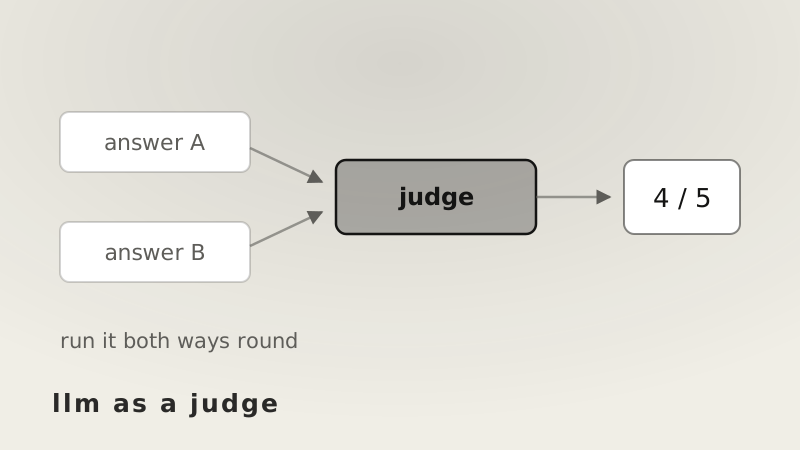
Open-ended output is hard to score. There is no single right answer to compare against, so the two traditional options are people, which does not scale, and word-overlap metrics, which measure whether the same words appeared rather than whether the answer was any good.
Using a model as the grader gets you judgement that understands meaning, at a rate that lets you evaluate everything rather than a sample.
Four ways to ask
Score one answer. Rate it 1 to 5 on a criterion. Simple, and the least reliable — absolute scores drift between runs and cluster in the middle.
Compare two answers. Show both, ask which is better. Far more stable, because relative judgements are easier than absolute ones. This is also where the worst bias lives.
Compare against a reference. Show the model answer and a known-good one, and ask how close they are in substance. Needs ground truth, which you often do not have.
Score against a rubric. Several named criteria, each scored separately, each with a stated definition. More work to set up, and the most usable in practice — a single number tells you something got worse, whereas a rubric tells you which part.
The bias you can cancel
In pairwise comparison, judges systematically favour whichever answer they read first. This is not subtle and it is not rare.
But it has a convenient shape. Suppose the judge's honest preference for answer A is , and being shown first adds :
| true preference | bias | A shown first | B shown first | mean of both |
|---|---|---|---|---|
| 0.70 | 0.15 | 0.850 | 0.550 | 0.700 |
| 0.70 | 0.05 | 0.750 | 0.650 | 0.700 |
| 0.85 | 0.10 | 0.950 | 0.750 | 0.850 |
| 0.55 | 0.20 | 0.750 | 0.350 | 0.550 |
Run each comparison in one order only and the winner's score is inflated by exactly . Run it in both orders and average, and the bias cancels precisely — over two is .
So every pairwise comparison should be run twice with the answers swapped. It doubles the cost and removes an entire category of error.
Disagreement is information
There is a second thing the swap gives you free. When the two orders disagree, the judge did not have a real preference — position decided it.
So the flip rate across your evaluation set is a direct measure of how much the judge is actually distinguishing. If half your comparisons flip when swapped, the scores are noise dressed as measurement — and no amount of averaging fixes that, because there is nothing underneath.
Treating flipped comparisons as ties rather than forcing a winner is usually the honest thing to do.
The other biases
These do not cancel, and have to be designed around.
Length. Longer answers score higher, roughly regardless of content. The cheapest partial defence is to state in the rubric that length is not a criterion, and to check whether your judge's scores correlate with word count — if they do, you have measured verbosity.
Style. Bullet points, headings, confident phrasing. A well-formatted wrong answer beats a plainly-written right one more often than it should.
Self-preference. A judge rates output from its own model family more highly. Which means evaluating your own model with a judge from the same family is not an independent measurement.
Confidence. Hedged but correct loses to assertive but wrong. The judge is reading tone as evidence.
Making it usable
The judge must be at least as strong as what it grades. A weaker judge cannot recognise the failures it is being asked to find, and will grade fluency instead.
Ask for reasoning before the score, not after. A model that writes its verdict first and justifies it afterwards is producing a rationalisation. Reasoning first genuinely changes the score it lands on.
Keep the scale short. 1–5 with each point defined beats 1–100, where nothing distinguishes 72 from 76 and the judge will not use the range consistently anyway.
Validate against people once. Score a hundred examples by hand, run the judge on the same hundred, and check they agree. Without that, you have automated a measurement of unknown validity — and it will be trusted precisely because it produces numbers.
Use more than one judge for anything important. Models from different families disagree in different directions, and the cases where they disagree with each other are the cases worth looking at.
The short version
- One model grades another's open-ended output, at a scale human review cannot reach.
- Pairwise comparison is more reliable than absolute scoring; a rubric tells you what got worse.
- Position bias is real and inflates the first-shown answer by a fixed amount.
- Running both orders and averaging cancels it exactly.
- The disagreement rate between orders measures how much the judge is really distinguishing.
- Length, style, self-preference and confidence biases do not cancel and need designing around.
- Reasoning before the score, a short scale, a judge at least as strong as the model, and one validation against humans.